
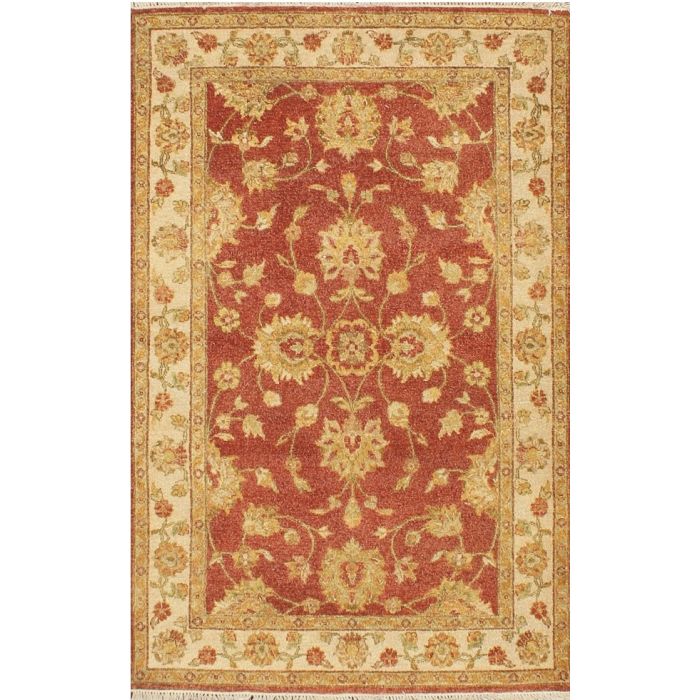
Rugsville Millenia Vegetable Dyes Wool 10186 Carpet
In stock
Complete your setup
Check Delivery
by · · Free shipping
Description / Rugsville Millenia Vegetable Dyes Wool 10186 Carpet
The loom is the oldest computer. It holds a programme of warp and weft and lets the weaver assemble a picture one knot at a time. The natural composition here was drafted on graph paper, scaled to the loom, and tied row by row over months.
3 weavers shared the loom for 6 months. 1.4 million hand-tied asymmetric knots, each one set against a vertical beam by feel rather than by counting. The pile is hand-spun wool, chosen for its long staple and its ability to hold vegetable dye to deep saturation without losing the slight tonal variation that gives a hand-knotted rug its patina. The foundation is cotton, which holds the rug flat and square through decades of use.
The composition
The natural ground carries the persian drawing without competing with it. The colour is not flat. Hand-spun yarn dyed in small lots produces faint horizontal banding called abrash, the signature of weaving made in batches rather than runs. Over the next decade the saturation will settle, the lighter passages will warm, and the rug will read as a single matured surface rather than a new object.
What you are buying
An entry point to collecting hand-knotted work, made on the same loom and with the same knot structure as pieces five times the price. 3 weavers, 6 months, 1.4 million knots. The wool develops patina with use, which is the signature distinction between a hand-knotted rug and a printed or tufted one.
The piece in a room
size as listed settles into a dining or sitting arrangement where the rug shows on all four sides of the furniture above it. The natural field warms the room under low evening light and reads cool under daylight. Direct sun helps the dyes mature; the colour you see now is the start of a long change.
Conservation
Vacuum on suction, no beater bar. Rotate twice a year. Blot, never rub, when something spills. Have the rug professionally hand-cleaned every five to seven years by a conservator who knows wool. A hand-knotted rug looked after this way is the only object on your floor that gains value with age.
Reference
- Medium: hand-knotted New Zealand wool on cotton foundation
- Dimensions: size as listed
- Construction: Persian asymmetric knot
- Knot density: ~120 KPSI
- Total knot count: ~1.4 million
- Hands: 3 weavers, 6 months
- Pile: 10 mm
- Dye: vegetable-dyed (madder, indigo, walnut hull)
- Origin: India
Free delivery across India. Cash on delivery available. 7-day exchange. Arrives rolled and wrapped for protection.
More Information
| Handmade | Yes |
|---|---|
| Color | Red & Rust |
| Colors | Rust |
| Life Stage | Adult, Teen |
| Carpet Styles | Oriental & Persian |
| Carpet Weave | Hand Knotted |
| Carpet Material | Wool |
| Recommended Use | Indoor |
| Collections | Ziegler |
| Brand | Rugsville |
Auspicious Placement
Vastu Guidance
Traditional Vastu Shastra recommendations for placing this carpet in your home. Choose based on the room and the corner you wish to ground.
Recommended direction: South-west (stability), or under the seating in the West / North-west.
Earth-tone carpets (red, ochre, terracotta, brown) in the South-west bring stability and grounding energy. Avoid covering the central Brahmasthan (centre) of the room; leave a small bare floor space.
Recommended direction: South-west or West side of the bed.
Soft pastels (cream, dusty rose, sage, blue-grey) work well in bedrooms for restful energy. Avoid bright reds at the head of the bed. Place the carpet so it extends 18–24 inches on each side of the bed.
Recommended direction: West or North-west zone.
Place carpet under the dining table such that all chairs sit on it when pulled out. Earth tones (terracotta, ochre, beige) and floral patterns are auspicious. Avoid black or dark blue under the dining area per Vastu.
Recommended direction: North-east corner of the home or the pooja room itself.
Auspicious colours: maroon, deep red, saffron, ivory, gold-yellow. Wool naturally resists fire risk near diya lamps. Use a small 2'×3' or 3'×5' size — larger carpets are not traditional in pooja spaces. Sit facing East or North while praying.
Recommended direction: Just inside the main door (East or North-facing entrance is ideal).
A small 3'×5' carpet at the entrance brings welcoming energy. Choose warm tones (red, ochre, gold). The carpet should be in good condition — frayed or stained welcome mats are considered inauspicious.
Vastu guidance is traditional and may vary by region and family practice. Consult a Vastu expert for personalised advice.
Rugsville Millenia Vegetable Dyes Wool 10186 Carpet
₹29,999