
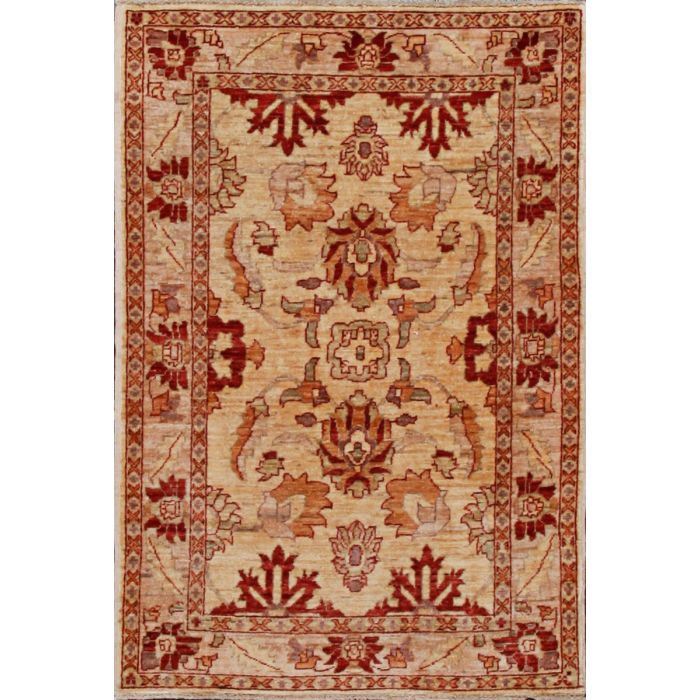
Nodi Persian Sultanabad Beige Hand Knotted Wool Carpet 3' X 5'
In stock
Only 1 left in stock — order soon
Complete your setup
Check Delivery
by · · Free shipping
Description / Nodi Persian Sultanabad Beige Hand Knotted Wool Carpet 3' X 5'
The Sultanabad pattern moved into beige grounds in the early twentieth century when American buyers asked for rugs that would read against the new oak and walnut floors of Arts and Crafts interiors rather than against the dark mahogany of the Victorian period before. The drawing was kept, the saturation was lifted, and what came out was a quieter Sultanabad that suits modern rooms as easily as it suited the Craftsman bungalow. Nodi works in that line.
One weaver worked this 3' x 5' (91 x 152 cm) runner across about three months in India. Wool was hand-spun, knotted on a cotton foundation in the Persian asymmetric style. The beige ground is undyed wool washed once after the loom came down. The figures carry muted indigo, soft red, sage, and ochre in the open Sultanabad spacing rather than the dense court repeat.
The composition
A beige field running close to natural sheep wool. Open Sultanabad floral figures spaced across the field in a slow rotation. A single main border in muted indigo with paired ivory guard stripes. The drawing has rest between figures, which is the signature of the Sultanabad register. The beige will warm with light and the figures will settle, and the rug gains weight as a composition over the first decade.
What you are buying
Authentic Sultanabad runners with documented attribution and intact condition trade at the major Western auctions in the range of $4,000 to $9,000. This is contemporary weaving in the same tradition, on the same loom geometry, by hand, in the same fibre. A hand-knotted Sultanabad appreciates with use rather than depreciating, which is a property no machine alternative shares.
The piece in a room
3' x 5' (91 x 152 cm) reads at the foot of a bed, in a pooja or mandir corner, beside a writing desk, or in a small entryway. The beige and muted indigo register sits against light oak, against waxed teak, against limestone, against painted plaster. The piece reads warm under brass lamp light and cool under daylight.
Conservation
Rotate the runner end for end every six months. Vacuum weekly, suction only, no beater bar. Blot spills with a clean cotton cloth at the moment of incident. A wool-trained hand wash every six to seven years keeps the lanolin and the colour honest. The piece runs three generations of careful ownership.
Reference
- Medium: hand-knotted wool on cotton foundation
- Dimensions: 91 x 152 cm (3' x 5')
- Construction: Persian asymmetric knot
- Hands: 1 weaver, ~3 months
- Pile: 8 mm
- Origin: India
Free shipping anywhere in India. Cash on delivery available. 7-day exchange.
More Information
| Handmade | Yes |
|---|---|
| Color | Beige |
| Colors | Beige |
| Life Stage | Adult, Teen |
| Carpet Styles | Oriental & Persian |
| Carpet Weave | Hand Knotted |
| Carpet Material | Wool |
| Recommended Use | Indoor |
| Carpet Shape | Runner |
Auspicious Placement
Vastu Guidance
Traditional Vastu Shastra recommendations for placing this carpet in your home. Choose based on the room and the corner you wish to ground.
Recommended direction: South-west (stability), or under the seating in the West / North-west.
Earth-tone carpets (red, ochre, terracotta, brown) in the South-west bring stability and grounding energy. Avoid covering the central Brahmasthan (centre) of the room; leave a small bare floor space.
Recommended direction: South-west or West side of the bed.
Soft pastels (cream, dusty rose, sage, blue-grey) work well in bedrooms for restful energy. Avoid bright reds at the head of the bed. Place the carpet so it extends 18–24 inches on each side of the bed.
Recommended direction: West or North-west zone.
Place carpet under the dining table such that all chairs sit on it when pulled out. Earth tones (terracotta, ochre, beige) and floral patterns are auspicious. Avoid black or dark blue under the dining area per Vastu.
Recommended direction: North-east corner of the home or the pooja room itself.
Auspicious colours: maroon, deep red, saffron, ivory, gold-yellow. Wool naturally resists fire risk near diya lamps. Use a small 2'×3' or 3'×5' size — larger carpets are not traditional in pooja spaces. Sit facing East or North while praying.
Recommended direction: Just inside the main door (East or North-facing entrance is ideal).
A small 3'×5' carpet at the entrance brings welcoming energy. Choose warm tones (red, ochre, gold). The carpet should be in good condition — frayed or stained welcome mats are considered inauspicious.
Vastu guidance is traditional and may vary by region and family practice. Consult a Vastu expert for personalised advice.
Nodi Persian Sultanabad Beige Hand Knotted Wool Carpet 3' X 5'
₹39,999