
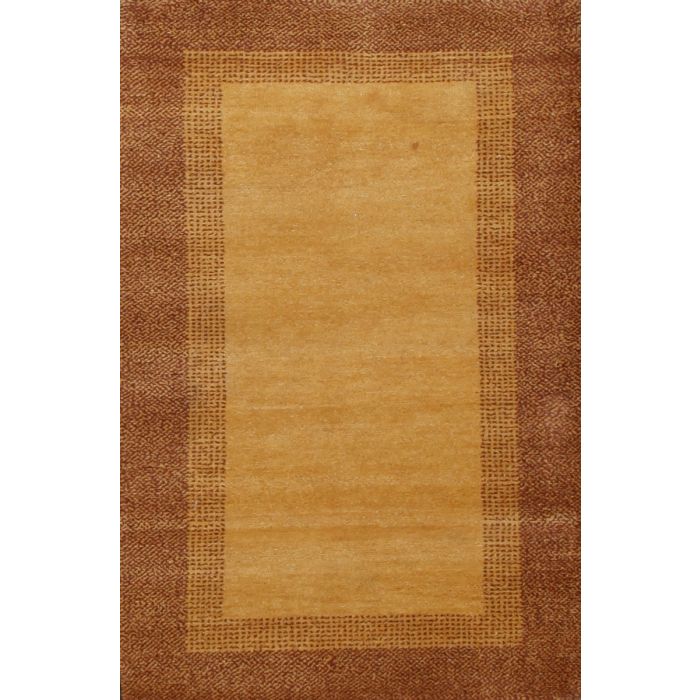
Gora Gabbeh Gold Hand Knotted Wool Carpet 3' X 5'
In stock
Only 1 left in stock — order soon
Complete your setup
Check Delivery
by · · Free shipping
Description / Gora Gabbeh Gold Hand Knotted Wool Carpet 3' X 5'
Gabbeh weaving comes from the Lori and Qashqa'i shepherds of southwestern Iran, a tribal practice in which the rug carries the herd's wool to market in the form of a thick-pile floor covering. The vocabulary is small. A field of one or two colours, a few abstracted lions or trees of life, and the abrash drift that signals hand-spun yarn and small dye baths. The Gora reading of the tradition pulls the field into a warm gold register and treats the design as poetry rather than catalogue.
One weaver worked the loom for around three and a half months over the 3' x 5' (91 x 152 cm) length. Hand-spun wool ran through the pile at a deliberately heavy weight, knotted at the low density that Gabbeh demands so the chunky plush is preserved. Dye was prepared from saffron-toned plant matter and walnut hull in the gold register, and from indigo and madder for the small motifs. The shear was set high to leave the wool with breath.
The composition
A gold field. A handful of tribal incident, perhaps a stylised tree or a row of small animal forms, scattered with the casual confidence of a weaver who is improvising rather than copying a cartoon. The ground itself is the subject, with abrash bands of slightly different yellow drifting across the field as the dye batches change. Over a decade the gold lifts toward honey, the indigo cools, and the wool develops the patina that distinguishes Gabbeh from any other weaving school.
What you are buying
Antique Qashqa'i Gabbehs from the 1880-1930 period regularly clear $3,000 to $7,000 at European tribal auction. This is a new weaving in the same hand, on the same upright loom, in the same low-density count and high pile, and the rug appreciates with use rather than depreciating with age. The wool patinas the way leather does, the design has been in continuous demand for a hundred years, and no other floor object holds value through wear.
The piece in a room
3' x 5' (91 x 152 cm) suits a bedside, a foyer, a pooja or mandir room, or a window seat. The gold ground warms rooms with cool plaster and grey stone, and pairs with walnut, oak, and brass. The high pile rewards bare feet and softens the acoustic of a hard-surfaced room.
Conservation
Vacuum gently on low suction, beater bar off, so the long pile is not pulled. Rotate the runner every six months to spread traffic. Lift spills with a dry cotton cloth before any liquid is applied. A wool conservator wash every five to six years keeps the dye saturated and the wool open. Gabbeh wool runs fifty years and beyond.
Reference
- Medium: hand-knotted hand-spun wool on cotton foundation
- Dimensions: 91 x 152 cm (3' x 5')
- Construction: Persian asymmetric knot, low density Gabbeh
- Hands: 1 weaver, ~3.5 months
- Pile: high, hand-spun wool
- Dye: vegetable
- Origin: India
Free shipping anywhere in India. Cash on delivery available. Seven-day exchange.
More Information
| Handmade | Yes |
|---|---|
| Color | Yellow & Gold |
| Colors | Gold |
| Life Stage | Adult, Teen |
| Carpet Styles | Oriental & Persian |
| Carpet Weave | Hand Knotted |
| Carpet Material | Wool |
| Recommended Use | Indoor |
| Carpet Shape | Runner |
Auspicious Placement
Vastu Guidance
Traditional Vastu Shastra recommendations for placing this carpet in your home. Choose based on the room and the corner you wish to ground.
Recommended direction: South-west (stability), or under the seating in the West / North-west.
Earth-tone carpets (red, ochre, terracotta, brown) in the South-west bring stability and grounding energy. Avoid covering the central Brahmasthan (centre) of the room; leave a small bare floor space.
Recommended direction: South-west or West side of the bed.
Soft pastels (cream, dusty rose, sage, blue-grey) work well in bedrooms for restful energy. Avoid bright reds at the head of the bed. Place the carpet so it extends 18–24 inches on each side of the bed.
Recommended direction: West or North-west zone.
Place carpet under the dining table such that all chairs sit on it when pulled out. Earth tones (terracotta, ochre, beige) and floral patterns are auspicious. Avoid black or dark blue under the dining area per Vastu.
Recommended direction: North-east corner of the home or the pooja room itself.
Auspicious colours: maroon, deep red, saffron, ivory, gold-yellow. Wool naturally resists fire risk near diya lamps. Use a small 2'×3' or 3'×5' size — larger carpets are not traditional in pooja spaces. Sit facing East or North while praying.
Recommended direction: Just inside the main door (East or North-facing entrance is ideal).
A small 3'×5' carpet at the entrance brings welcoming energy. Choose warm tones (red, ochre, gold). The carpet should be in good condition — frayed or stained welcome mats are considered inauspicious.
Vastu guidance is traditional and may vary by region and family practice. Consult a Vastu expert for personalised advice.
Gora Gabbeh Gold Hand Knotted Wool Carpet 3' X 5'
₹53,999