
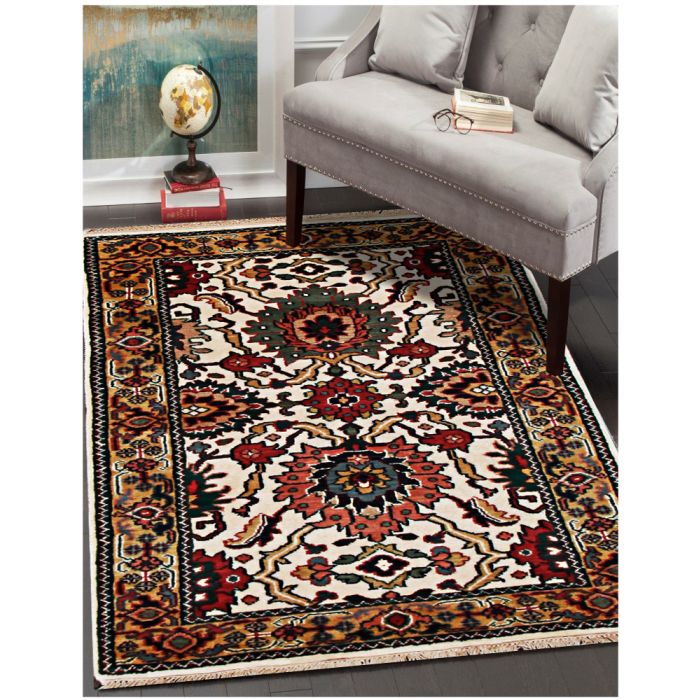
Abby Persian Sultanabad Ivory Gold Hand Knotted Wool Carpet 3' X 5'
In stock
Only 1 left in stock — order soon
Complete your setup
Check Delivery
by · · Free shipping
Description / Abby Persian Sultanabad Ivory Gold Hand Knotted Wool Carpet 3' X 5'
By the late 1800s, the looms of Sultanabad in western Iran had loosened the dense floral repeats of classical Persia into the open ivory grounds and gentle vine work that the Anglo-American collector preferred. Ziegler & Co. of Manchester ran a buying office that commissioned weavers to a softer palette of madder, ochre, and indigo, and the design vocabulary that came out of that decade is still the most-copied template in the trade. Abby works from the Sultanabad reference book, in a runner format suited to the contemporary Indian flat.
One weaver worked the upright loom for roughly four months over the 3' x 5' (91 x 152 cm) length. Hand-spun wool was knotted by feel against a vertical beam in the Persian asymmetric system. The pile was dyed with madder root, walnut hull, and saffron-toned mineral mordants, each colour matured for a fortnight in copper vats before the wool was lowered. The rug was washed twice after the loom, then sun-dried on a flat bed to set the dye and lock the lustre.
The composition
An ivory ground carries a quiet vine in soft gold, faded rust, and walnut brown, with the curl of leaf and palmette running corner to corner. A single deep guard stripe holds the field rather than the layered border that turns lesser Sultanabads heavy. Over the next ten years the gold lifts toward honey, the rust calms toward rose, and the ivory warms by a half tone into bone. The drift of colour is the slow signature of plant dye.
What you are buying
Antique Sultanabad runners of similar density and 1890-1920 attribution trade at Christie's, Sotheby's, and Rippon Boswell in the $4,000 to $8,000 band when they appear at auction. This is a new weaving in the same tradition, on the same loom, in the same wool, and the rug appreciates with use rather than depreciating against time. No other floor object holds value through age the way a vegetable-dyed Sultanabad does.
The piece in a room
3' x 5' (91 x 152 cm) suits a foyer, the foot of a bed, a reading chair, a pooja room, or a quiet hall between two reception spaces. The ivory and gold ground pairs with walnut, brass, leather, and cool plaster. Soft side light reads the colour shifts best, while harsh overhead spots flatten the abrash.
Conservation
Rotate the runner end for end every six months so light and traffic age it evenly. Vacuum on suction only with the beater bar off. Blot spills with a clean cotton cloth and never rub at the pile. A hand wash by a wool conservator every five years preserves the dye and lustre, and the rug runs seventy years and beyond.
Reference
- Medium: hand-knotted wool on cotton foundation
- Dimensions: 91 x 152 cm (3' x 5')
- Construction: Persian asymmetric knot
- Hands: 1 weaver, ~4 months
- Pile: hand-spun wool
- Dye: vegetable (madder, walnut hull, mineral mordants)
- Origin: India
Free shipping across India. Cash on delivery available. Seven-day exchange on every order.
More Information
| Handmade | Yes |
|---|---|
| Color | Tan & Ivory |
| Colors | Ivory |
| Life Stage | Adult, Teen |
| Carpet Styles | Oriental & Persian |
| Carpet Weave | Hand Knotted |
| Carpet Material | Wool |
| Recommended Use | Indoor |
| Carpet Shape | Runner |
Auspicious Placement
Vastu Guidance
Traditional Vastu Shastra recommendations for placing this carpet in your home. Choose based on the room and the corner you wish to ground.
Recommended direction: South-west (stability), or under the seating in the West / North-west.
Earth-tone carpets (red, ochre, terracotta, brown) in the South-west bring stability and grounding energy. Avoid covering the central Brahmasthan (centre) of the room; leave a small bare floor space.
Recommended direction: South-west or West side of the bed.
Soft pastels (cream, dusty rose, sage, blue-grey) work well in bedrooms for restful energy. Avoid bright reds at the head of the bed. Place the carpet so it extends 18–24 inches on each side of the bed.
Recommended direction: West or North-west zone.
Place carpet under the dining table such that all chairs sit on it when pulled out. Earth tones (terracotta, ochre, beige) and floral patterns are auspicious. Avoid black or dark blue under the dining area per Vastu.
Recommended direction: North-east corner of the home or the pooja room itself.
Auspicious colours: maroon, deep red, saffron, ivory, gold-yellow. Wool naturally resists fire risk near diya lamps. Use a small 2'×3' or 3'×5' size — larger carpets are not traditional in pooja spaces. Sit facing East or North while praying.
Recommended direction: Just inside the main door (East or North-facing entrance is ideal).
A small 3'×5' carpet at the entrance brings welcoming energy. Choose warm tones (red, ochre, gold). The carpet should be in good condition — frayed or stained welcome mats are considered inauspicious.
Vastu guidance is traditional and may vary by region and family practice. Consult a Vastu expert for personalised advice.
Abby Persian Sultanabad Ivory Gold Hand Knotted Wool Carpet 3' X 5'
₹53,999